

In today’s fast-paced and innovation-driven business environment, the product management job role of a Product Manager (PM) has become absolutely indispensable. As companies race to build better products, compete in saturated markets, and meet ever-rising customer expectations, the product manager stands at the center. To land this crucial role, your resume must clearly articulate your ability to align vision, strategy, and execution. This guide answers the core question: how do you translate the complex product management functions into a powerful, results-driven resume?
This comprehensive guide not only breaks down the core product management duties of a product manager but also provides actionable resume guidance, including a Product Manager resume example, best practices, and tips for showcasing your product manager skills effectively. Whether you’re an aspiring PM or a seasoned professional with many years of experience, this expanded guide will help you understand the product manager job profile deeply and create a product manager resume that stands out.


Download Our Free Resume Template!
⭐ What Does a Product Manager Do?
A product manager acts as the bridge between engineering, business teams, marketing, stakeholders, and customers. Their product manager job roles and product manager role description ensure a product: ✔ aligns with business goals ✔ solves real customer problems ✔ is executed efficiently across departments
PMs operate at the intersection of business, technology, and user experience (UX) — making decisions that guide the product from concept → development → product launch → growth. They are responsible for the entire product development process.
However, product management is not a one-size-fits-all role. Depending on industry and company size, product managers may focus more on:
- Technical feasibility (e.g., in SaaS, AI, or robotics) — often fulfilled by a technical product manager.
- Market trends & consumer insights (e.g., retail, FMCG)
- Revenue and growth strategy (e.g., startup PMs)
This requires PMs to be analytical, adaptable, and excellent communicators. They fulfill the complex job desc product manager requirements.

⭐ Core Responsibilities of a Product Manager
The detailed product manager job description and requirements encompass several critical areas:
1. Defining the Product Vision & Strategy Every successful product begins with a strong vision. Successful product managers:
- Study market landscapes
- Analyze competitors
- Identify customer pain points
- Lead vision-setting sessions with executives
This means PMs must:
- Understand market trends
- Align strategy with business objectives
- Inspire confidence across cross-functional teams A compelling vision allows teams to move in the same direction with clarity and enthusiasm.
2. Conducting Market Research & Customer Insights Strong PMs rely heavily on data. They gather insights from:
- customer interviews
- surveys
- usability tests
- analytics dashboards
This research helps PMs:
- discover unmet customer needs
- identify new opportunities
- validate product concepts
- shape product positioning
Developing detailed customer personas helps PMs create targeted and customer-centric products. This requires deep data analysis capabilities.
3. Building & Managing the Product Roadmap A product roadmap is the blueprint that guides feature development. PMs must:
- prioritize features based on impact
- align roadmap items with stakeholder goals
- balance short-term wins vs. long-term strategy
- set deliverable timelines
A roadmap is a living document — constantly updated as markets, customers, and priorities evolve.
4. Leading Cross-Functional Collaboration Product managers collaborate daily with:
- engineers
- designers
- data analysts
- marketing
- sales
- customer success
- Sometimes even filling the functions of a project manager.
They ensure everyone understands: ✔ the product vision ✔ priorities ✔ deadlines ✔ desired customer outcomes
This is where PMs use communication and negotiation skills to mediate conflicts and keep teams aligned.

5. Overseeing Product Development & Lifecycle PMs are accountable for every stage in a product’s lifecycle:
- Early Development: Write product requirements, Coordinate prototypes and product design iterations, Align with engineering on technical feasibility.
- Launch: Plan go-to-market strategy, coordinate marketing, sales, and support teams.
- Post-Launch: Analyze performance metrics, collect customer feedback, plan improvements and new features.
This continuous cycle ensures the product evolves with customer and market demands.
6. Prioritizing Features & Managing Releases Feature prioritization requires trade-offs. PMs must:
- balance stakeholder requests
- assess technical complexity
- analyze business value
- make tough decisions, often resulting in data driven decisions.
Using frameworks like RICE, MoSCoW, or Kano, PMs ensure resources go toward the most impactful work.
7. Monitoring Product Metrics & Performance PMs define KPIs such as:
- user engagement
- retention rate
- churn
- revenue growth
- customer satisfaction
- feature adoption
With data, they decide what to improve, iterate, or sunset.
⭐ Skills & Qualifications of a Product Manager
To meet the high product manager requirements, a great product manager usually excels in the following skill sets:
1. Communication & Leadership
- articulating vision
- aligning cross-functional teams
- resolving conflicts
- inspiring collaboration These are high level leadership traits.
2. Analytical Thinking
- interpreting data
- identifying trends
- solving user and business problems This requires strong analytical skills.
3. Technical Proficiency PMs aren’t engineers — but they understand:
- system limitations
- APIs
- product architecture
- new technologies This helps them make smarter decisions with engineering teams. Many PMs benefit from a background in computer science or strong technical knowledge for this aspect.
4. Business Acumen PMs must understand:
- revenue models
- budgeting
- market positioning
- pricing strategy Their decisions significantly influence profitability.


Upload your resume now!
⭐ Challenges Product Managers Commonly Face
1. Balancing Stakeholder Expectations Managing conflicting priorities is constant — customers want features fast, engineers need more time, executives push for revenue.
2. Adapting to Market Changes PMs must stay agile and pivot strategies quickly.
3. Working with Limited Resources Prioritization is essential when budgets, engineering time, or team capacity is limited.
📊 Putting Analytical Skills into Action: PM Scenarios
The ability to move from high-level vision to ground-level detail is what separates a good PM from a great product manager. These scenarios illustrate how analytical skills and data analysis are applied daily.
- Scenario 1: The Revenue Plateau. A product manager notices that subscription revenue has flatlined despite steady traffic.
- Action: The PM uses analytical skills to conduct data analysis (e.g., A/B testing, cohort analysis via tools like Mixpanel or Amplitude) to pinpoint the exact drop-off point, perhaps realizing users are abandoning the payment page due to friction.
- Outcome: The PM makes a data driven decision to simplify the checkout process, resulting in a 10% lift in conversion, thus solving the revenue problem.
- Scenario 2: The Stakeholder Pivot. The CEO demands the team immediately shift focus to building a new, unproven feature, jeopardizing the planned product launch.
- Action: The PM doesn’t simply say “no.” Instead, they use their technical knowledge and existing product roadmap data to create a risk-analysis matrix (cost vs. impact), demonstrating the severe timeline delay and the potential loss of value from the already-completed features.
- Outcome: Through effective cross-functional collaboration, the PM negotiates a smaller MVP (Minimum Viable Product) of the new feature for later in the quarter, protecting the original strategic product launch.
- Scenario 3: The Technical Debt Crisis. Engineering reports that mounting technical debt is slowing the product development process to a halt.
- Action: The PM works with the engineering lead to quantify the business cost of technical debt (e.g., “it adds 20% overhead to every new feature”). The PM then champions dedicating 20% of the next few sprints to refactoring, treating the technical work as a high-priority feature.
- Outcome: This decision ensures the long-term health of the product, showcasing the PM’s strategic thinking and ability to balance short-term user needs with long-term product viability—a hallmark of successful product managers.
⭐ Career Path & Salary Expectations
Product management offers fast career growth and many potential product manager positions within established career paths:
- Associate Product Manager
- Product Manager
- Senior PM
- Director of Product
- VP of Product
- Chief Product Officer (CPO)
The product manager salary is competitive and varies by location, industry, and seniority.
🤝 Organizational Context: Where PMs Intersect
Understanding the full product manager job profile requires knowing how the PM role differs from, and interacts with, other key functions. The PM acts as the central hub, but they are distinct from project manager and product owner roles.
- Product Manager vs. Project Manager:
- The Product Manager (PM) focuses on what should be built and why (Strategy, Vision, Market Fit). They own the product roadmap and P&L.
- The Project Manager focuses on how it will be built and when (Execution, Timeline, Resource Management). They manage the execution of a defined plan. A PM may sometimes temporarily fill the functions of a project manager, but their core responsibility remains the product strategy.
- Product Manager vs. Product Owner (in Scrum):
- The PM maintains the high level product vision and strategy for the market.
- The Product Owner (PO) is a role within the Scrum team, primarily focused on managing the development backlog, defining user stories, and representing the customer to the engineering team. In smaller companies, the PM often performs both roles.
- Product Manager vs. Product Marketing Manager (PMM):
- The PM defines the product (what it is).
- The PMM defines the message and how the product is sold (how to take it to market). They handle competitive positioning, messaging, and sales enablement, working closely with the PM during the product launch phase.
⭐ Product Manager Resume Guide
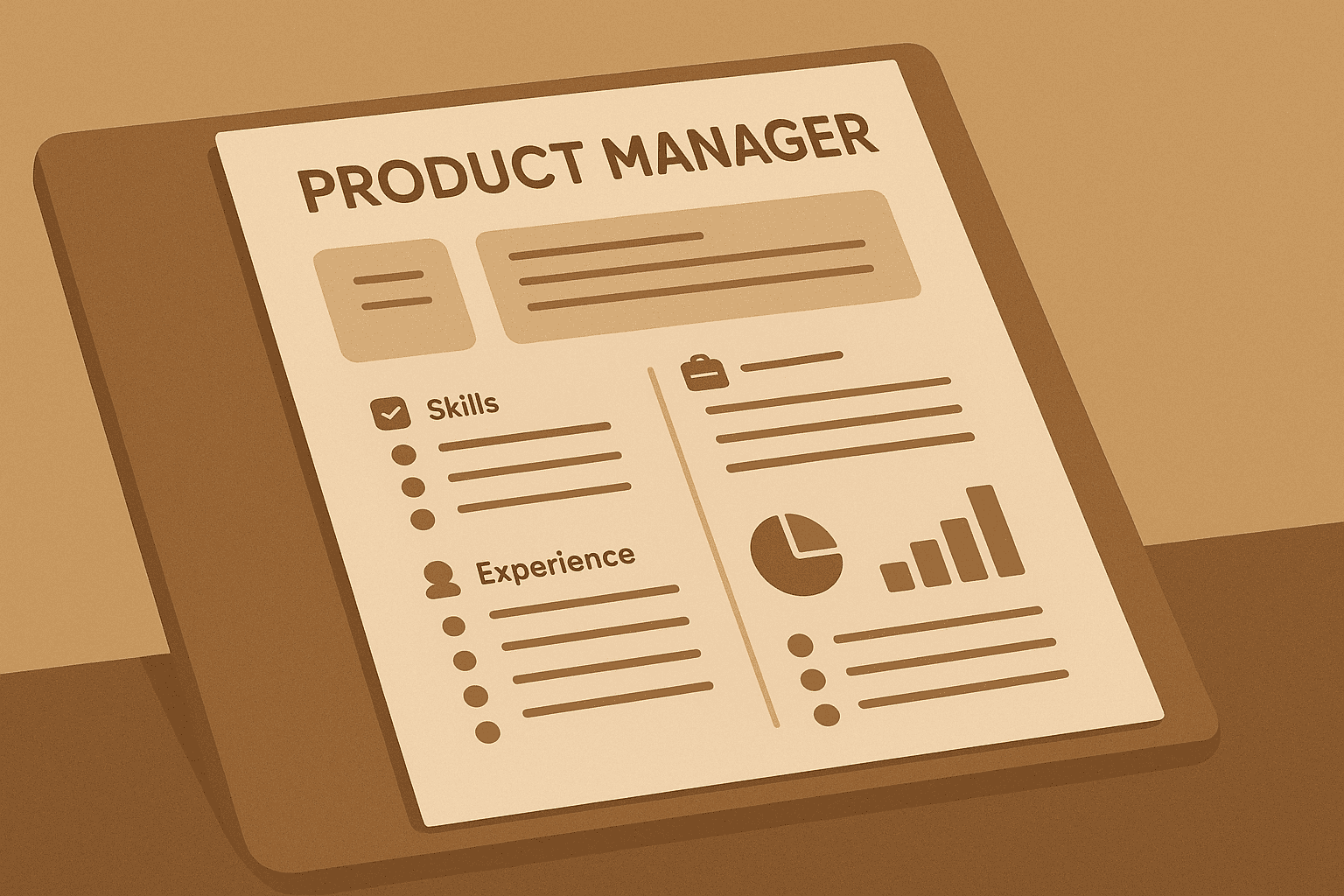
A well-crafted Product Manager Resume is essential for standing out in a competitive job market. Hiring managers and Applicant Tracking Systems (ATS) look for resumes that demonstrate leadership, analytical ability, and user-centric thinking.

Use AI to Instantly Fix Your Resume
Below is a guide inspired by your warehouse resume format:
How to Write a Strong Product Manager Resume
1. Start with a Powerful Product Manager Summary
- Example: “Product Manager with 5+ years of experience driving strategy, leading cross-functional teams, and launching data-driven features. Skilled in roadmap planning, user research, and optimizing customer experiences to increase product adoption and revenue growth.”
2. Highlight Technical & Analytical Skills
- Roadmap development
- User research & usability testing
- A/B testing
- SQL / Analytics tools (Amplitude, Mixpanel, GA4)
- Agile & Scrum
- Jira, Trello, Notion
- Wireframing (Figma, Balsamims)
3. Showcase Achievements with Metrics
- Instead of: ❌ “Responsible for product planning.”
- Use: ✅ “Increased user retention by 18% by redesigning onboarding flow based on user research insights.” Metrics = credibility.
4. Add a Product Manager Resume Example
- Product Manager – TechCorp Innovations
- San Francisco, CA | 2020–Present
- Led end-to-end development of a mobile app used by 2M+ users
- Increased subscription revenue by 24% through pricing model optimization
- Created product roadmaps aligning with company OKRs and secured executive buy-in
- Collaborated with engineering to reduce page load time by 30%
- Conducted market research that identified 3 new market opportunities worth $8M
⭐ Conclusion
The role of a product manager is multifaceted, strategic, and essential to any successful organization. By mastering communication, research, leadership, and technical skills and understanding, PMs drive innovation and ensure their products succeed in the market.
Whether you’re aspiring to enter this field or aiming to refine your skills, understanding PM responsibilities — and presenting them effectively on your resume — is the key to building a successful product manager career
Author Information: Osmar Zidane – Market Research Specialist
Osmar Zidane is a data-driven and analytical Market Research Specialist with a foundation in Industrial Engineering. His background equips him with strong skills in process optimization, problem-solving, and quantitative analysis — all of which translate seamlessly into marketing and consumer insights.

